- HOME
- Find Instruments and Buy
- Bookmark
- Browsing History
- Easy Buyback Assessment
- Premium Selection
- Category List
- Brand List
- Easy Search
- Musical Instrument Store List
- Guitar Technique
 JAPANESE
- HOME
- Find Instruments and Buy条件を選んで絞り込みながら探す
- Advanced Search詳細条件を設定して一発で探す
- Easy Searchギターや楽器をワンクリックで探す
- Category Listギターや楽器の種類から探す
- Brand List楽器メーカーやブランド名から探す
- Musical Instrument Store Listギターショップ・楽器店を探す
- New Arrivals新着楽器を登録日ごとに表示
- Premium Selectionビンテージ&プレミアム
- SALE!公式セール・店舗セール・タイムセール
- 値下げ商品!セール以外でもお買得楽器が満載!
- Browsing History
- Bookmark
- Easy Buyback Assessment全国の楽器店が無料で査定!
- Guitar Technique完全無料の人気ギター講座
- JAPANESE
- 閉じる


- HOME
- Guitars/Basses/Stringed Instruments
- Classical/Flamenco Guitars
- Flamenco Guitars
- Sobrinos de Domingo Esteso [ソブリーノス・デ・ドミンゴ・エステソ] Flamenco Negra 1973年 Vintage 1601384 Sobrinos de Domingo Esteso [ソブリーノス・デ・ドミンゴ・エステソ]【楽器検索|Jギター】
Sobrinos de Domingo Esteso [ソブリーノス・デ・ドミンゴ・エステソ] Flamenco Negra

![Sobrinos de Domingo Esteso [ソブリーノス・デ・ドミンゴ・エステソ] Flamenco Negra](https://sp.j-guitar.com/upload/save_image/06261221_6a3df04b59238.jpg_960_960.jpg)
![Sobrinos de Domingo Esteso [ソブリーノス・デ・ドミンゴ・エステソ] Flamenco Negra_2](https://sp.j-guitar.com/upload/save_image/06261221_6a3df050c9cca.jpg_960_960.jpg)
![Sobrinos de Domingo Esteso [ソブリーノス・デ・ドミンゴ・エステソ] Flamenco Negra_3](https://sp.j-guitar.com/upload/save_image/06261221_6a3df0560de7a.jpg_960_960.jpg)
![Sobrinos de Domingo Esteso [ソブリーノス・デ・ドミンゴ・エステソ] Flamenco Negra_4](https://sp.j-guitar.com/upload/save_image/06261222_6a3df0593184b.jpg_960_960.jpg)
![Sobrinos de Domingo Esteso [ソブリーノス・デ・ドミンゴ・エステソ] Flamenco Negra_5](https://sp.j-guitar.com/upload/save_image/06261222_6a3df05ec8bff.jpg_960_960.jpg)
![Sobrinos de Domingo Esteso [ソブリーノス・デ・ドミンゴ・エステソ] Flamenco Negra_6](https://sp.j-guitar.com/upload/save_image/06261222_6a3df062af97b.jpg_960_960.jpg)
![Sobrinos de Domingo Esteso [ソブリーノス・デ・ドミンゴ・エステソ] Flamenco Negra_7](https://sp.j-guitar.com/upload/save_image/06261222_6a3df0660e99e.jpg_960_960.jpg)
![Sobrinos de Domingo Esteso [ソブリーノス・デ・ドミンゴ・エステソ] Flamenco Negra_8](https://sp.j-guitar.com/upload/save_image/06261222_6a3df069ae2c1.jpg_960_960.jpg)
![Sobrinos de Domingo Esteso [ソブリーノス・デ・ドミンゴ・エステソ] Flamenco Negra_9](https://sp.j-guitar.com/upload/save_image/06261222_6a3df06d630ee.gif_960_960.gif)
HOLD解除メールを設定する
Product Description
Neck:Cedro
Fingerboard:Ebony
Finish(Top):Lacquer
Finish(Back & Sides):Lacquer
Tuning Machines:Vangent
String Height(1st):2.7mm
String Height(6th):3.9mm
[Luthier Information]
Among the many distinguished flamenco guitar brands in Spain, Conde Hermanos stands as one of the most iconic and enduring. The origins of the brand trace back to the legendary workshop of Manuel Ramírez (1864–1916) in Madrid, where Domingo Esteso (1882–1937) worked as a luthier alongside Santos Hernández (1874–1943). In 1919, Esteso established his own workshop on Gravina Street in Madrid, laying the foundation for what would become the Conde legacy.
Esteso’s craftsmanship was passed directly to his nephews — Faustino Conde (1913–1988), Mariano Conde (1916–1989), and Julio Conde (1918–1995) — who joined the workshop as apprentices. After Esteso’s death, the three nephews continued guitar making under the label “Viuda y Sobrinos de Domingo Esteso” (Widow and Nephews of Domingo Esteso). When Esteso’s widow (Nicolasa Salamanca, who had also handled guitar finishing) passed away in 1959, the label was changed to “Sobrinos de Domingo Esteso / Conde Hermanos”, marking the emergence of the now-famous Conde Hermanos name.
In the 1960s, the Conde brothers modernized the instrument's internal structure and design, moving away from the traditional Esteso blueprint. This period also saw the introduction of the now-iconic Media Luna (half-moon) headstock shape, which became synonymous with their high-end models. The growing international demand for flamenco guitars during this time helped solidify their global reputation.
In 1980, Mariano established a new workshop on Calle Felipe V in Madrid, working alongside his sons Felipe Conde I and Mariano Conde II. Though initially collaborating with the Gravina workshop, the Felipe V workshop became independent after Faustino's death in 1988. The passing of Mariano I in 1989 saw his sons officially take over, and the Felipe V shop soon became the most commercially adaptive and responsive of the Conde workshops.
In 2010, the two brothers branched out independently — Felipe Conde and Mariano Conde — each establishing their own brand while maintaining the traditional craftsmanship of Conde Hermanos, infused with their individual artistic vision.
Meanwhile, the Gravina workshop, overseen by Faustino’s widow into the 2000s, has since closed. Julio Conde operated a separate workshop established in the 1950s on Calle Atocha. After Julio’s passing in 1995, his daughter and granddaughter took over, continuing to produce instruments under the Conde Hermanos label.
Conde Hermanos guitars have been famously played by Paco de Lucía, among many other renowned flamenco guitarists, and remain essential instruments for serious flamenco enthusiasts worldwide.
[Instrument Details]
This is a 1973 “Sobrinos de Domingo Esteso”–labeled Conde Hermanos flamenco guitar, a rare short-scale model (648 mm scale length) from this distinguished maker. Featuring Indian rosewood back and sides, this is the so-called negra model, offering greater tonal depth and sustain compared to traditional blanca models. The body depth is also notable: approximately 96 mm at the neck joint and 104 mm at the lower bout, suggesting this guitar may have been either a custom order or part of an experimental series produced during this period.
The top bracing is a unique configuration:
Two harmonic bars above the soundhole, with the spaces in between filled with thin reinforcement plates.
Two harmonic bars below the soundhole, the one near the bridge installed at a slight diagonal.
Narrow (approx. 2 cm) reinforcement strips are placed along each side of the soundhole, connected to short vertical braces that run upward toward the neck, aligned with the fan-brace geometry rather than the curve of the sides — a non-standard approach.
Below the waist, the top is supported by seven symmetrical fan braces, with two V-shaped closing bars at the bottom, and a full-size bridge plate. The guitar's main resonance is set between G♯ and A.
This bracing style — with its seven fan braces and vertically oriented side braces — bears clear influence from the designs of Ignacio Fleta, offering a rich, full-bodied tone. The sound is notably warm, smooth, and direct, with controlled response and excellent clarity, while maintaining all the necessary characteristics for flamenco performance.
The body is finished in lacquer, showing fine weather checking throughout — common for instruments of this age. There are no visible cracks in the wood. The soundboard has typical play wear, with considerable finish wear near the soundhole (now protected by a golpeador plate).
Neck and frets are in good playing condition, though the neck angle is slightly steeper than typical for flamenco guitars, resulting in slightly higher action: 2.7 mm (bass) / 3.9 mm (treble) at the 12th fret.
Saddle height is low (approx. 0–1 mm of adjustment space).
Some fret leveling issues are noted beyond the 13th fret but do not impact normal playing.
Detailed Information
| 商品名 | Sobrinos de Domingo Esteso [ソブリーノス・デ・ドミンゴ・エステソ] Flamenco Negra |
|---|---|
| Product ID | 1601384 |
| Instrument Category | Guitars/Basses/Stringed Instruments > Classical/Flamenco Guitars > Flamenco Guitars |
| Brand | Sobrinos de Domingo Esteso [ソブリーノス・デ・ドミンゴ・エステソ] |
| Model Number / Model | フラメンコネグラ |
| Instrument Classification | Vintage |
| Year | 1973Year |
| Condition | 3+[EX] |
| Top Material | Spruce |
| Side and Back Material | Rosewood |
| Colors | Natural/Wood Grain |
| Country of Manufacture | Spain |
| String Length | 648mm |
| Case | 軽量ケース |
| Accessories | クロス |
| Release Date | 2026/08/03 |
| Update Date | 2026/08/03 |
Guitar Shop AURA

| Street Address | 〒110-0004 2F Azul Ueno, 3-3-5 Shitaya, Taito-ku, Tokyo 110-0004, JAPAN |
|---|---|
| Access | 5 minutes walk from Exit No.3 or No.4 of Iriya Station on Subway(Hibiya Line) or 10 minutes walk from South Exit of Uguisudani Station on JR Yamanote Line. |
| TEL / FAX | TEL:+81-(0)3-3876-7207 / FAX:03-3876-7206 |
| Business Hours / Regular Holiday | Eleven am to seven pm. / Wednesday are closed. |
| Home Page | http://www.guitarra.jp/top_e/ |
| Product Type | New, Used, Vintage |
| Product Category | Acoustic Guitars/Electric Acoustic Guitars, Classical/Flamenco Guitars, Accessories, Other Instruments, CD/DVD/Books/Sheet Music/Teaching Material |
| Supported Services / Facilities |
|
| J-Guitar Payment |
| Store Name | Guitar Shop AURA |
|---|---|
| Company Name | AURA Co., Ltd. |
| Location | 2F Azul Ueno, 3-3-5 Shitaya, Taito-ku, Tokyo 110-0004, JAPAN |
| Mail Address | info@guitarshop.jp |
| Business Hours | Eleven am to seven pm. |
| Seller | |
|---|---|
| Representative Or Responsible Person | |
| Location | - 0 |
| Phone Number | -- |
| Selling Price | |
| Fees other than sale price required | |
| Payment method and time period | |
| Delivery Period | |
| Application Period申込み有効期限 | |
| Guarantee | |
| Guarantee ・ Return ・ Cancel | |
| Sale quantity limit and other special conditions |
| Name | 株式会社アウラ |
|---|---|
| Public safety commissions | 東京都公安委員会 |
| Permission Number | 第306619505019号 |
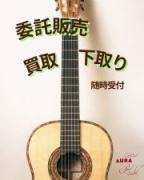
委託販売、買取、下取りのお申し込みは随時受け付けております。
現役の手工製作家によるメンテナンスチェックを実施し、楽器の状態を確認させて頂き正確な査定を致します。
大切な楽器を、「安心」と共に次のユーザーへと引き継ぐことを心掛けています。

確かな技術で、楽器の故障状況を的確に把握し、また、隠れた故障、潜在的な故障を見逃すことなく、適切な修理方法をご提案致します。
深刻な故障でもあきらめる前にまずはご相談下さい。
割れ、はがれ、傷等の破損や故障の補修。音質改善のためのナットとサドルの調整。
弾き心地改良のためのネック反り補正や、弦高、弦幅等を奏者に合わせるフィッティング調整。
更に再塗装、塗り重ね、フレットや糸巻きの調整や交換等の経年劣化に対しての補修、修理まで専門家の知識と技で、あらゆる問題点に関してのご相談、見積もり、リペアまで責任を持って承ります。担当制で木曜・土曜・日曜に各製作家がギターショップアウラに常駐しております。
お困りのことが御座いましたらお気軽に電話でご相談ください。
また、各担当製作家は、スペイン伝統工法に忠実に則り楽器を製作している現役製作家。
使用材からネック幅、弦幅、弦長などディテールを細かく指定出来るオーダーメイドについても製作家と直接ご相談頂けます。
名工から譲り受けた貴重材を使用するプレミアムオーダーメイドも受け付けております。


東京都内に、上野入谷・秋葉原・学芸大学・池袋の5教室を展開している「アウラ音楽院」。クラシックギター、フラメンコギターのみならず、ウクレレ、エレキギター、マンドリン、ポルトガルギターなど・・それぞれの講師達が得意とする分野の歴史と伝統の中で培われた技術を、自然と身に付けて行く事が出来ます。ギター初心者からプロ志望の方まで、課題や目的が違うひとりひとりとじっくり向き合い、講師と一緒に夢の実現に向けて上達を目指せる教室です。
コンサート活動やCD発売など活躍中の現役のプロミュージシャンや、指導経験豊富なプロ講師が多数講師として在籍。ギター専門店アウラとして、自信を持っておすすめできる講師陣で皆様をお迎えしています。
また、小さなお子様でも続けやすいキッズコース、お友達や家族とのペアレッスンなど多様なご要望に対応しており、「長く続けやすい」と皆様にご支持いただいております。

![Satoru Sakuma [佐久間 悟] ロマニリョスモデル No.45](https://sp.j-guitar.com/upload/save_image/07271423_6a66eb4cab275.jpg_230_230.jpg)


![Antonio Marin Montero [アントニオ・マリン・モンテロ] Modelo B(Bouchet) No.430](https://sp.j-guitar.com/upload/save_image/09241334_6ab4a85d14c91.jpg_230_230.jpg)
![Arcangel Fernandez [アルカンヘル・フェルナンデス] classical](https://sp.j-guitar.com/upload/save_image/09101525_6aa24d4b23773.jpg_230_230.jpg)

![Hironori Fukuda [福田 寛紀] Classical](https://sp.j-guitar.com/upload/save_image/09241418_6ab4b2aa051ca.jpg_230_230.jpg)
![Kuniharu Nobe [野辺 邦治] 10-string classical guitar](https://sp.j-guitar.com/upload/save_image/09241443_6ab4b888be483.jpg_230_230.jpg)
![Joao Carlos Jeronimo Bras [ジョアン・カルロス・ブラス] Double Top No.12](https://sp.j-guitar.com/upload/save_image/09291422_6abb4b218963a.jpg_230_230.jpg)
![Osamu Nakade [中出 治] FC25](https://sp.j-guitar.com/upload/save_image/08311423_6a950fd14607d.jpg_230_230.jpg)
![Mitsuru Tamura [田村 満] No.1000](https://sp.j-guitar.com/upload/save_image/08311411_6a950d109a5d1.jpg_230_230.jpg)
![Jose Ramirez III [ホセ・ラミレス 3世] 1a A926](https://sp.j-guitar.com/upload/save_image/09241429_6ab4b54642ce9.jpg_230_230.jpg)
![Manuel Velazquez [マヌエル・ベラスケス] classical](https://sp.j-guitar.com/upload/save_image/06081245_6a263ac56538b.jpg_230_230.jpg)
![Santos Hernandez [サントス・エルナンデス] Classical (Flamenco) Model](https://sp.j-guitar.com/upload/save_image/09061430_6a9cfa917413a.jpg_230_230.jpg)
![Hermann Hauser II [ヘルマン・ハウザー2世] Segovia No.968](https://sp.j-guitar.com/upload/save_image/09041305_6a9a4398ae2df.jpg_230_230.jpg)